Ronnie McGrath’s fatal overdose and staged death scene
Hide and SeekRonnie McGrath’s fatal overdose and staged death scene begins as an apparent drug death and becomes a suspected murder investigation. The heroin Ronnie injected was lethal, but his body’s carefully described position and the objects arranged around it complicate the initial explanation. John Rebus must distinguish the known cause of death from the uncertain actions that followed it—and from the possibility that someone has tried to make those actions disappear into an ordinary overdose case.
Causes and Setting
Ronnie’s death takes place against the drug crisis in Edinburgh. A doctor tells John Rebus that intravenous drug use is widespread in the city, with the number of users probably in the hundreds, and connects that prevalence to a serious AIDS burden. The observation places Ronnie’s addiction within a larger public-health emergency rather than presenting it as an isolated personal failing. It also sharpens the danger of the supply itself: the heroin recovered in connection with the death was reported to be 95 percent impure. The substance used to dilute it had not yet been identified, but the doctor’s educated guess ranged from ground aspirin to rat poison, with particular concern that it might be a rodent poison. The uncertainty about the exact contaminant does not lessen the doctor’s conclusion that the batch was lethal.
The physical setting makes that vulnerability visible. Ronnie’s home is in Pilmuir, where long grass and weeds overtake landscaped areas, playgrounds are damaged, and many houses have boarded windows, broken drainage, and neglected gardens. A few hundred yards away, a developer advertises new private apartments as a luxury development under the name Muir Village. John Rebus recognizes the gap between that promotional image and the estate around Ronnie’s house. This contrast does not establish the cause of Ronnie’s death, but it locates the case in a city where deprivation and redevelopment sit close together, while dangerous drugs circulate through the lives of people with little protection from their risks.
Discovery and the Scene
Police cars and an ambulance are already outside Ronnie’s house when John Rebus arrives. A burnt-out Ford Cortina stands nearby; the house, like its neighbours, has boarded windows, but its door is open onto a dark interior. The emergency vehicles mark the death as an official matter, while the open door and the deserted, deteriorating surroundings give the arrival an uneasy sense of exposure and abandonment.
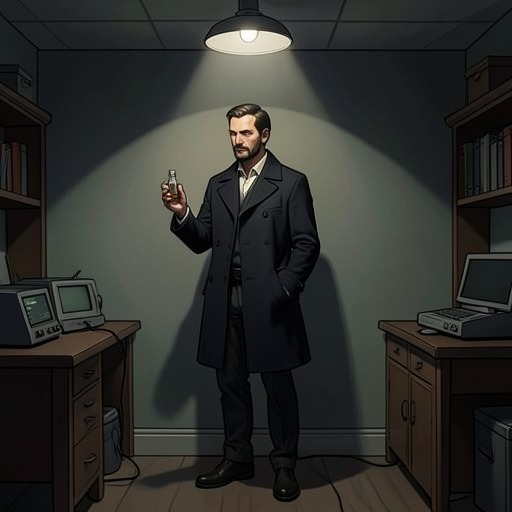
The scene is not simply a body beside evidence of drug use. In explaining it to Matthew Vanderhyde, John Rebus describes Ronnie as lying with his arms stretched wide and his legs together. He was shirtless, rather than completely naked. Candles had burned on either side of him, a pentagram had been painted on a wall, and syringes were in a jar beside the body. The arrangement offers the appearance of an occult tableau, but it does not prove an occult cause. John Rebus raises the possibility of a sacrifice; Matthew Vanderhyde responds to that theory, while the available physical facts remain those of an overdose amid a deliberately striking arrangement.
From Overdose to Suspected Staging
The central investigative problem is the difference between how Ronnie died and how the scene came to look as it did. John Rebus accepts that Ronnie injected himself, but that fact alone cannot settle whether his death was accidental or whether someone supplied the lethal heroin knowing what it would do. He also considers a sequence in which Ronnie, after going without drugs, suddenly obtained a supply and injected it in an empty house. When Tracy came in, she reportedly found him in his room and panicked. Charlie questions that account, so John Rebus treats it as a working reconstruction rather than an established fact.
In that reconstruction, someone later moved Ronnie’s body downstairs. John Rebus does not know why: the move might have been intended to muddy the circumstances, or might have had some other explanation. A second packet of white powder then appears. Tracy had reported seeing only one packet, and John Rebus’s theory is that this later packet contained good heroin, unlike the lethal supply Ronnie had used. Ronnie’s camera also disappears from the house and later turns up in Charlie’s room at the squat. These details make the scene look potentially manipulated, but they do not, by themselves, identify who altered it or why. The distance between a clue and a proven account is part of what keeps the case unresolved at this point.
Evidence, Uncertainty, and Significance
At his desk, John Rebus writes down the apparent facts and recognizes how quickly they give way to conjecture. There is no suggestion that Ronnie did not inject himself. He had been deprived of his supply despite the wider availability of drugs in the city; someone moved his body and left a packet of apparently good heroin. John Rebus considers whether that packet was meant to be tested, found clean, and used to support a finding of death by misadventure. But rat poison was found, and the supposedly simple explanation cannot account neatly for all the evidence.
He then tests another possibility: Ronnie may have known that the heroin supplied to him was far from pure and taken it anyway, perhaps understanding that his supplier wanted him dead. That reading also fails to make the sequence clear. Rather than resolving the death with a confident accusation, the investigation exposes how incomplete its evidence remains: self-injection is compatible with both an overdose and a deliberate killing, while the moved body and substituted packet suggest intervention without conclusively establishing its author. Ronnie’s death is therefore both a fatal consequence of a contaminated drug supply and a scene whose presentation may have been manipulated. The occult signs, the evidence of injection, and the uneasy chain of packets and movements pull the case toward different explanations, leaving John Rebus to begin his reasoning again rather than mistake a plausible story for proof.